The Grid and the Mud | by Dino Buzzi
...



On the expedition that founded Buenos Aires for the first time, colonists and soldiers, though they had shelters at their disposal, decided to remain on the ships. The soldiery continued to dwell in the vessels even after the town had been founded. For months their abode was upon the waters of the Río de la Plata.
The first destruction of Buenos Aires consisted in striking the town and moving it elsewhere. Something of this don Pedro de Mendoza had learned some time before, commanding the sack of Rome. Fire was set to all the buildings and to the ship which, run aground, served as a defensive wall. In the desolate place, a letter was left inside a jug made from a gourd, inscribed with the indication of where the population had been moved.
“We beg and ask as a favor of anyone who may see this letter of ours, that if he should find himself unable, in time, to do any of the things we mention above by which to relieve us, and should he resolve to return to Spain or to some other part of the Indies, that he put this back as he found it, so that, if another should come after him, he may follow us and take with him the copy, so that by it he may report to His Majesty or to the lords of the House of Trade of the Indies, so that, knowing how matters stand, His Majesty may order us to be relieved if he be so served; for, owing to the lack of ships, may relief of the things necessary to this land be sent to us. This port is the best there is on this river for ships and people, where anyone who comes may leave the people and whatever else he sees fit, always taking care to guard against jaguars, for there are many.”¹
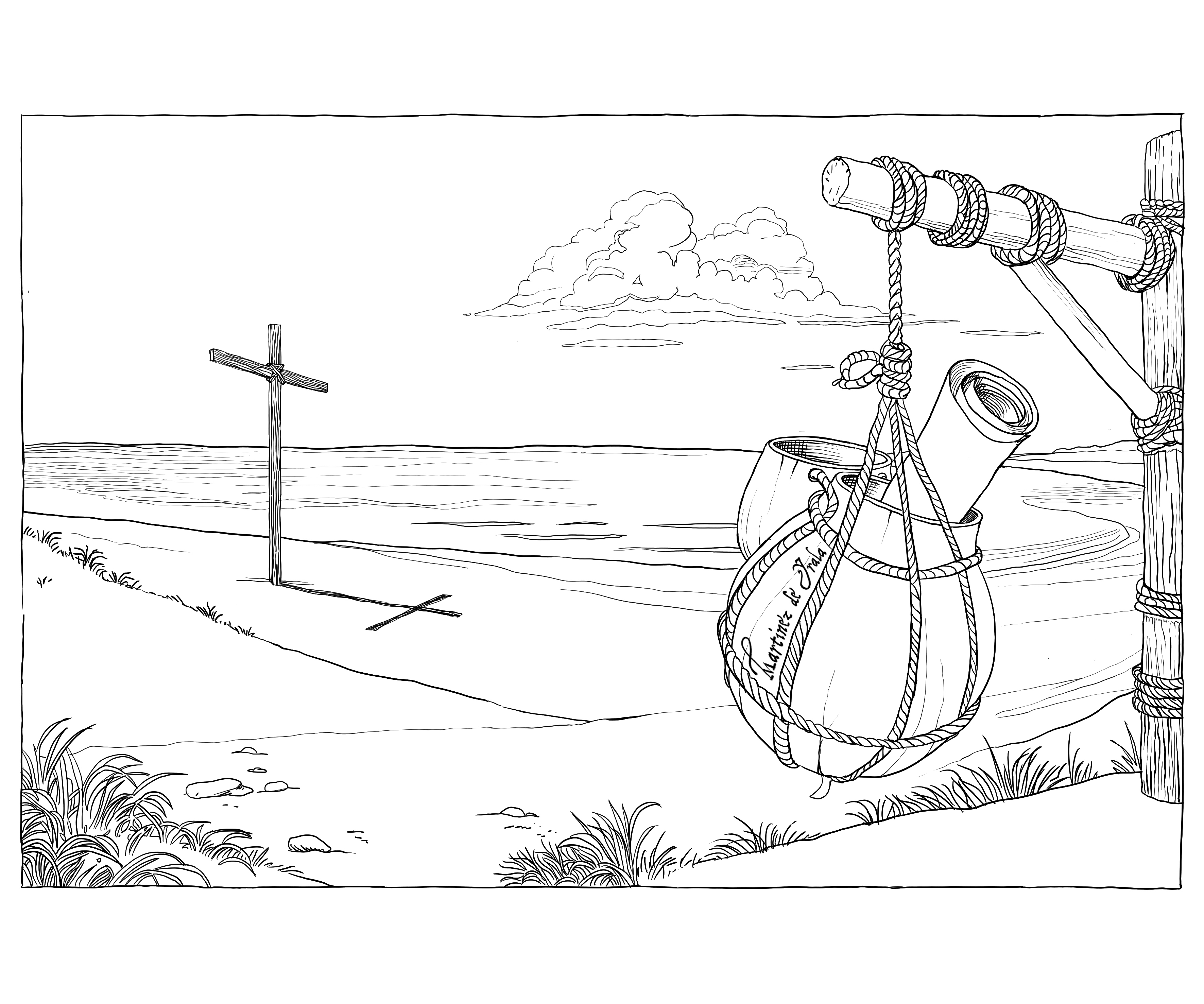
The vessels anchored in the estuary, those two ships of the first expedition, were not only a defensive device but an early sign. That recommendation described in the letter of Martínez de Irala, who, on his flight toward Asunción, assured that the Río de la Plata offered the best natural conditions as a port, could be considered the first deception perpetrated in Buenos Aires. Or at least, the first official sign of the desperation proper to the instinct of survival.
Two centuries after that advance, Buenos Aires had already consolidated itself as a smuggling port since the heyday of Potosí, though it had enormous needs to formalize itself in the face of the fragile infrastructure that displayed its precariousness.
“The city of Buenos Aires, sighted from the outer roadstead some eight miles away, has an imposing appearance. The public buildings and the domes of numerous churches give it a certain air of grandeur that vanishes as we draw near. On disembarking, the ruined pier (the storm of 21 August 1820 left it in poor condition) and the main streets near the coast dispose us ill toward the beauty of the city… The Río de la Plata might justly be called the ‘navigator’s hell’: some charts drawn up by Captain Heywood, of H.M.B. Nereus, though not perfect, may be considered the best. The government has ordered buoys placed on the Chico and Ortiz banks, and there has been much talk of building a pier, a dock, and other works of consequence. The services of a French engineer and a Quaker gentleman named Bevans have been contracted. The latter arrived from London in October 1822, but the lack of funds has prevented the projected undertaking. To raise piers and docks is no easy task in a country devoid of workers… A small navigation tax would become indispensable should so fundamental a work be undertaken… Those who, by reason of their occupations, must embark and disembark frequently find the carts too expensive, and some do not shrink from having themselves carried on the shoulders of the sailors. Rarely is there enough water to allow the ships to come close, and, moreover, there is always the danger of the rocks and shipwreck debris that lie along the coast.”²
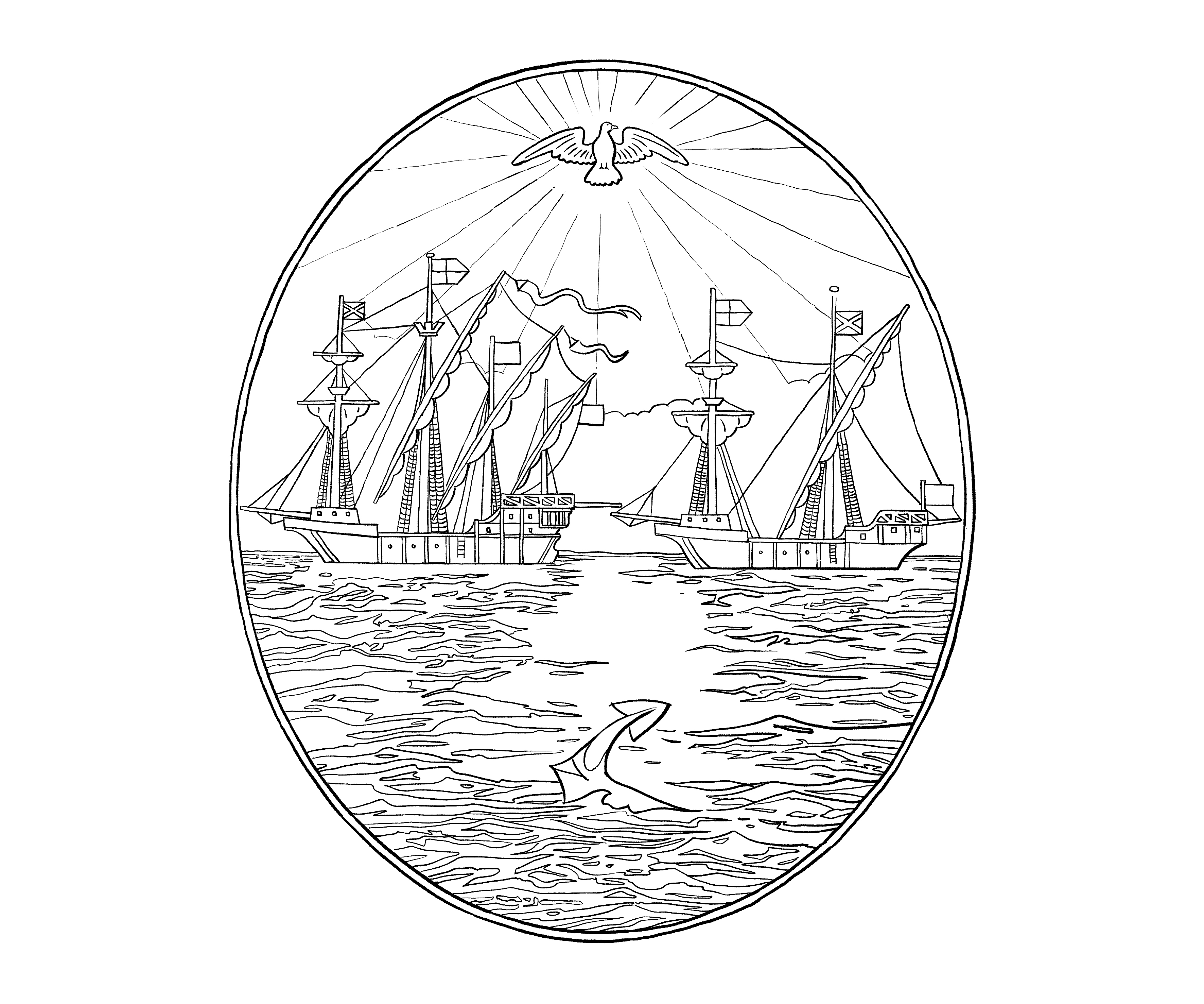
Since 1744 —twenty-two years before the creation of the Viceroyalty of the Río de la Plata, and eighty years before the preceding quotation, down to our own day— the coat of arms of the city of Buenos Aires has been represented by two vessels anchored in the river, with an anchor in the foreground to certify it and a dove above to symbolize the guardianship of the Holy Spirit, referring to the Catholic belief and presence in these lands, in this case represented by the water. The two ships of the first expedition thus constitute the myth of origin that encodes the dialectical meaning of the city as an amphibious piece and of the port as the inevitable metonymy of the city.
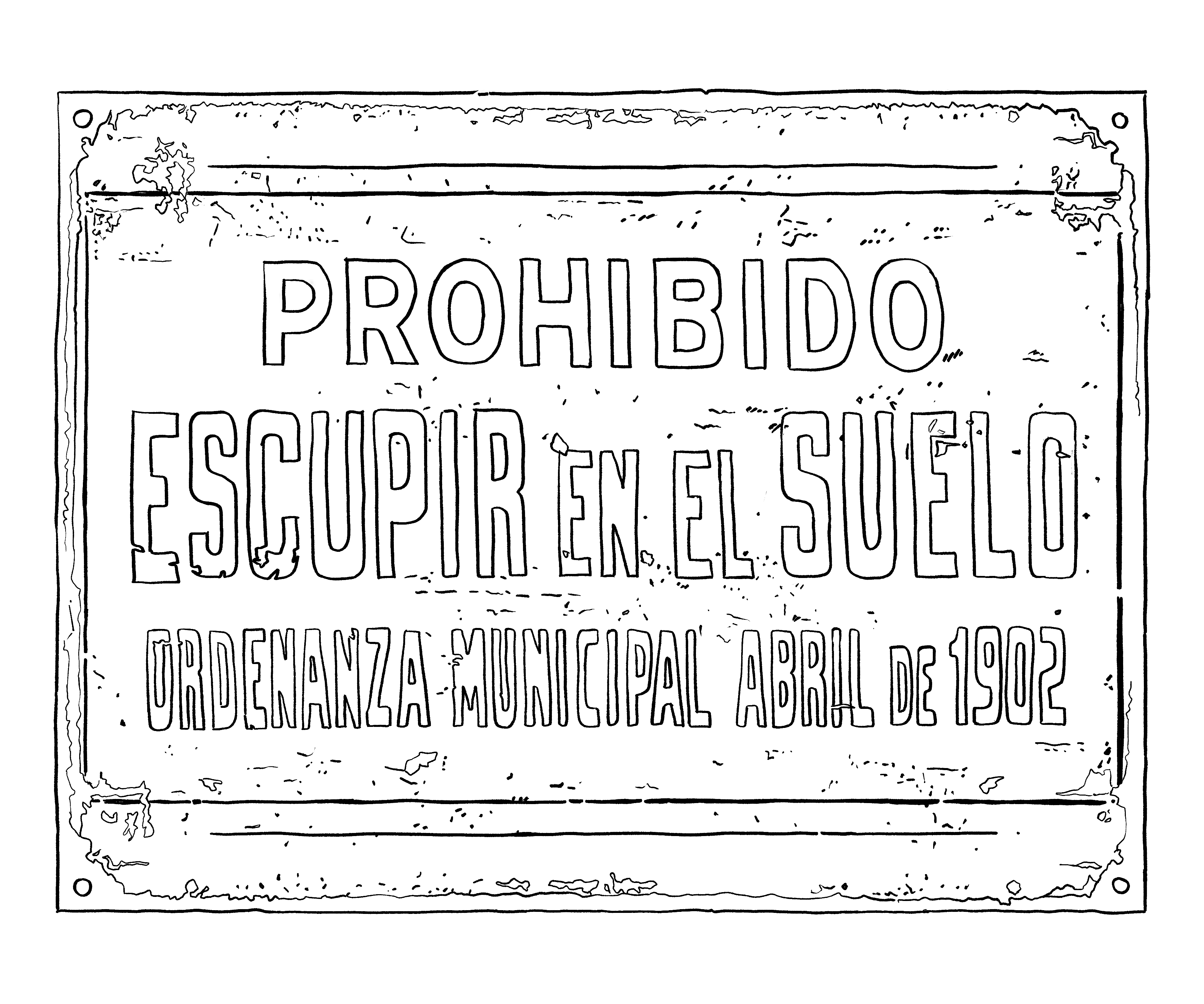
“Spitting on the ground is forbidden”. Municipal ordinance of 11/4/1902
That enameled tin sign screwed to the wall of the bar run by Spanish immigrants displayed a norm of coexistence that was once a commonplace of twentieth-century public space. The mere passing of time ended up installing in later generations a state of naturalization that led it to become only an innocent recommendation, and even a disregarded fact. This regulation, conceived some time later as an archetypal index of public courtesy —regularly known by the name of urbanity— had been validated, more than a hundred years earlier, by the omnipresence of tuberculosis as a matter of life or death.
Without pretending to overdo the irony, we ought to admit that to live or to die is the limit of human coexistence. That is perhaps why no urban plan has unleashed a greater transformation in its concrete effects than the one produced in the history of the city of Buenos Aires by the yellow fever epidemic of 1871, consolidating the territorial asymmetry of rich and poor with the migration of the well-to-do classes to the north of the metropolis then taking shape. At that moment the urban structure began to obey a scheme of social division delimited by margins of salubrity. The north-south scheme thus settled as the historical matrix expressed in urban development, in the differential establishment of the social elites, and consequently in the hierarchization and inequality of land values.
“The regularization of the city points to economic and administrative considerations translated into a concrete space; but also to an approach to problems in which what had traditionally been considered natural now appears as dangerous. It is in relation to this perspective that the miasmatic theories, which lent scientific basis to the spatial organization of the city, can be considered.”³
The river became the transmitting agent of the plague, emptying downstream from the Paraná, carrying the infected soldiers from the bloody scenes of the War of Paraguay, and through the contamination of the salting houses of the Riachuelo. Yellow fever spread with fulminating speed over the population and contributed to the consolidation of a new social order.
The life of the city finds in this founding catastrophe the supporting base for the exercise of a determining epochal tendency, such as the one enunciated by the hygienist doctrines that the medical-political class of Ramos Mejía, Coni, Wilde, Ingenieros, Holmberg, and Argerich, among so many, managed to place in the foreground of the stage of Argentine development driven by the Generation of ’80. The scientific paradigm finds a leading role as the sphere of solutions to the core of the problems that define the national civilizing model. Without doubt there existed a project of action, within the whole machinery of thought set in play in political action, which reverberated in a certain way in state intervention, and which has to do with the delicate position that assists citizens in times of the invisible terror of these epidemics of uncertain treatment.
“The plague that inhabits the narrow, lightless streets can come out of there and, carried by the wind, make its way into the cleanest and best-kept bedroom. Every poor person who lives badly is a threat against the lives of his fellow men.” (Eduardo Wilde, Course in Public Hygiene, 1878)
The miasmatic theory formulated in the seventeenth century then gained force as an argument for the construction of a common sense for the state’s organization of the city’s territory.
These levels of forced human solidarity enclosed in Wilde’s quotation, which came to be activated out of the impossibility of controlling circumstances and beyond any initial will, have today been transmuted into arguments in the experience with COVID. Current urban and social policies have glimpsed the possibilities afforded them by media engineering for the construction of rhetorics about the balance of the environment and, simultaneously or successively, about quite the opposite.
Argentina’s exit from the water-concession company —Aguas Argentinas— in 2006 constituted a central episode for thinking about the questions linked to a new appraisal of the environmental matters forgotten by the political agendas. The point of conflict, on its way to oblivion, was the failure to build the main treatment plant of the master drain that receives the effluents of the City of Buenos Aires and the most populous districts of its metropolitan area.
We shall then have to mention a new geographical opposition in order to understand the organic drive of Buenos Aires. The east-west relationship settled by its coastal front divides the limits of the city in the poetic-toned description imposed by the difference between the pampa and the river, its liquid pampa. Like a body that impulsively models its behaviors by force of images, Buenos Aires aspired over time to a literary intelligence defined by this duality, which has served strictly the geographic contrast of the narratives, but which has not worked to articulate an equally lucid system for the coexistence of urban settlements. The fiercest paradox of that relationship, beyond the one that designates it as a port city, is the one that turned the river into a dumping ground for waste and a source of consumption at the same time. The metaphor of the liquid pampa is so effective that, taking on a real appearance, it has for more than a hundred years turned our river into the greatest depository of fertilizer that any arable land could pride itself on, supposing, through this figure, that the water for consumption is also a good to be cultivated by fertilizing it. As a complement to this scenario, fifty percent of the metropolitan population still has no access to the sewage network.
The need to build a port for Buenos Aires became, in the first decades of the nineteenth century, an indispensable work. The shallowness of the river did not lessen the insistence that the port exist and take shape. The enormous number of ships anchored awaiting disembarkation, loading, and unloading —as the lithographs of Engelmann describe— defined a very particular image of that vast horizon the river has from the city. The decision to materialize it constituted the beginning of an institution that accompanies Argentines to this day: the foreign debt.
The London bank Baring Brothers then consummated, together with native and English speculators, the greatest swindle known in these lands, constituting itself as lender for the construction of the port of Buenos Aires along with three other ports on the coast. The history of the entertainment of money from the administration of Bernardino Rivadavia onward is that of an eighty-year drift. The concrete fact is that nothing agreed upon with the signing of the loan in 1824 was fulfilled. The works were not carried out, and the debt contracted multiplied tenfold by the time it was finally settled in 1904.
The National Port was finally built between 1887 and 1897, after the project was awarded in 1882 to Eduardo Madero, nephew of the then vice-president Francisco Madero. Eduardo Madero had presented other port projects earlier, in 1861 and 1869, and competed with the engineer Luis Huergo, disputing with him the possibility of taking on the work. The rivalry between the two proposals expressed the tension of two antagonistic groups confronting each other for the commercial and political hegemony of the national course.⁴
Buenos Aires finally had a national port on the Río de la Plata.
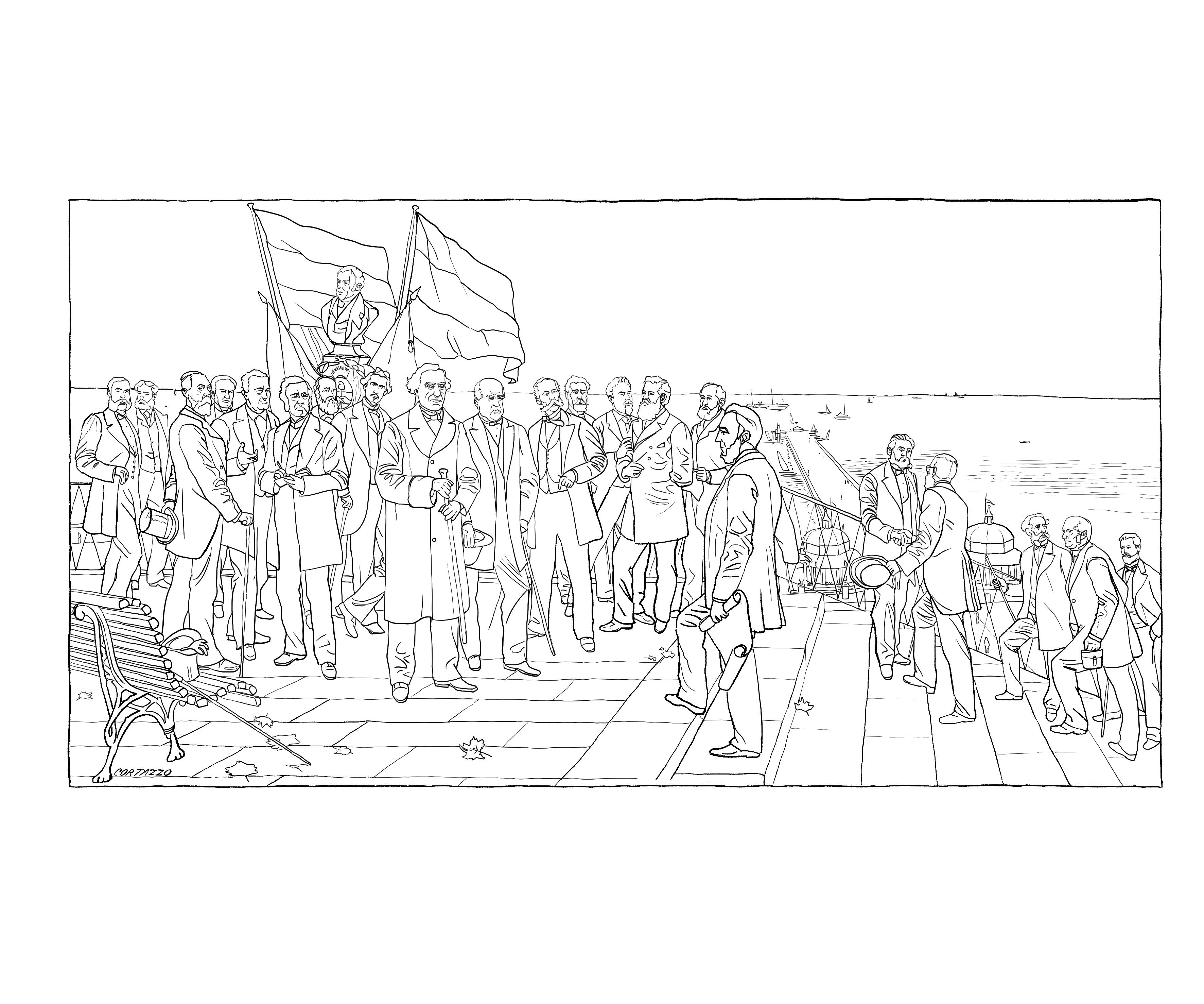
The oil painting by Oreste Cortazzo delivers an image that lends a degree of unsettling synthesis to this story. A small group of people gathered on the steps of the Paseo de Julio, facing the passenger pier, welcome Eduardo Madero, who carries with him the inauguration act of the first stage of the port. At the center of the image is Dalmacio Vélez Sarsfield, who was the drafter of the Civil and Commercial Code and who, having died in 1875, had no real opportunity to be present at that ceremony. To the right of the frame stands Domingo F. Sarmiento, Argentine president in the period 1868-1874, also deceased before the event and leader of the power group that prevailed in the aforementioned undertaking. This celebratory picture, which brings together this elite group, has a third presence at its back. It is the bust of Bernardino Rivadavia which, surrounded by Argentine flags, not only signals some kind of evocation of that first frustrated port but also reinforces the reason why Baring Brothers, in this case too, turned out to be the bank that financed the construction of what is today known as Puerto Madero.
Shortly after its inauguration, the technical problems that Huergo had foreseen in due time began to appear. Ten years after the work was finished, and due to the increase in the size of ships, the docks and the port became obsolete. The new version of the port built beside it followed the design of a comb-port perpendicular to the coast, which Huergo, the first engineer to graduate in Argentina, had presented in 1881. The Puerto Nuevo finally went into construction in 1907.
“The only solidified structure, the only segment of the sphere in which the lands appear differentiated from the waters, is the Public Administration, the shoals of the State. Its profiles and reliefs are demarcated with clarity; there those who fear life can find footing; but it is the mass of a water hyacinth, without inner consistency. It has the form of the chaotic components that make it up, and for that very reason it depends on fortuitous circumstances that, just as they made it a concrete figure, can undo it.”⁴
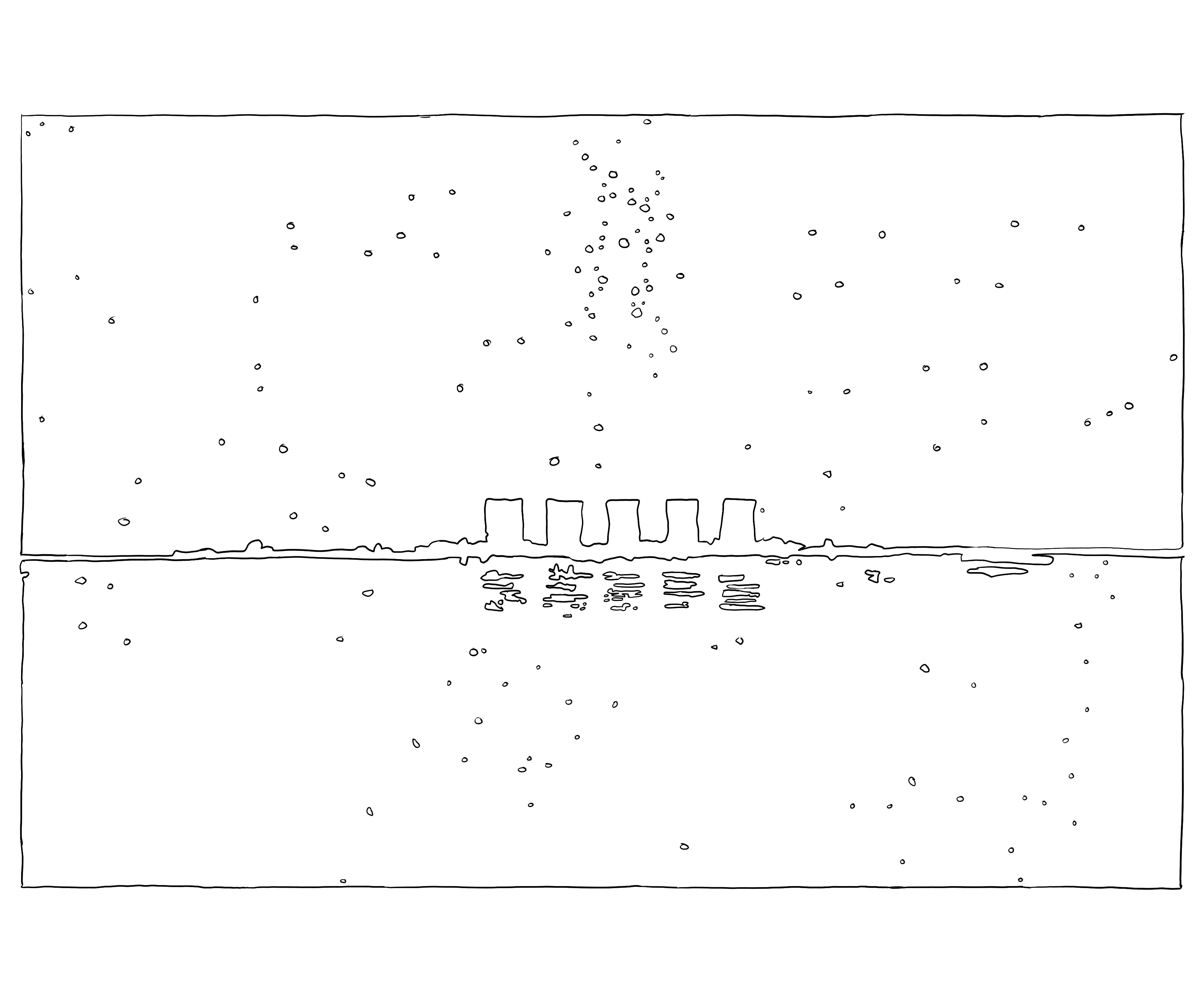
“I draw your attention to two singularly fortunate facts. The ground of the Pampa and of the city is not at the level of the river; it falls almost sheer by what you call ‘the barranca,’ a very pronounced slope, so pronounced that the primitive city stayed behind it. Thus, with our reinforced concrete, we are going to bring the ground of the city, level, above the river, forward, upon piles that will take their foundations in the compact clay of the bottom of the estuary, an excellent soil for raising skyscrapers. This bottom is no more than about eight to twelve meters below the level of the water.”5
The texts that make up the book Précisions —Précisions sur un état présent de l’architecture et de l’urbanisme, published in Paris in 1930 as part of the Collection de L’Esprit Nouveau— correspond to the lectures Le Corbusier delivered on his visit to Buenos Aires and Rio de Janeiro in 1929.
There, Charles-Édouard Jeanneret rehearsed his first intuitions about Buenos Aires, ideas that years later would take shape when he embarked, together with then-young Argentine architects, on the task of carrying forward the Plan Director for the City.
Invited to Argentina by Victoria Ocampo, in her role as promoter and disseminator of culture and the artistic avant-gardes, Le Corbusier made his appearance on the local scene wielding his customary hyperbolic language, whose tone was inevitably associated with the avant-garde style of artistic expression that only the few members of that group handled and understood as a discursive genre. However, the urbanistic questions he raised were not merely conversational flourishes: they carried grandiloquent actions and political decisions that went far beyond a mere expression of art.
The sensible matter of his entire proposal, synthesized in the presence of a set of skyscrapers raised in front of the city’s coast and above the river, turned out to be —beyond all the technical account, beyond the messianic overflow of an enlightened man— a repercussion of the latent spell of those two vessels that inhabited Buenos Aires for the first time without genuinely touching its soil. Le Corbusier’s City of Business, that which dwells within the shield, continued on its destiny by mutating that dreamed-of port into a city anchored like ships, exactly meters away from the old coastal edge where the Querandí watched the first Spanish expedition arrive.
Arquitecto.
Integra junto a Lucas Gilardi el equipo de arquitectura a77 donde desarrolla trabajos vinculados con la autoconstrucción y la reutilización de restos industriales y el reciclaje aplicados a la vivienda
experimental, a la formación de instituciones efímeras, a la activación de dinámicas sociales en el espacio público y a la autogestión de espacios culturales.
Profesor titular de la cátedra Taller a77 de Arquitectura y Proyecto Urbano en la Facultad de Arquitectura, Diseño y Urbanismo (FADU-UBA).
Profesor titular del Taller de Experimentación Proyectual y del Laboratorio de Experimentación Tecnológica del Instituto de Arquitectura y Urbanismo de la Universidad Nacional de San Martin (EHyS- IA-UNSAM).
Es uno de los miembros fundadores del espacio IF /Investigaciones del Futuro, plataforma y espacio de pensamiento y producción de proyectos culturales y de inserción en entornos vulnerables.
Es autor de escritos y ponencias sobre asuntos urbanos y arquitectura. Sus trabajos construidos han tenido lugar en Buenos Aires, Barcelona y Nueva York y han sido exhibidos en múltiples exposiciones nacionales e internacionales.
Entre sus distinciones se destaca la obtención del premio Kónex de Platino al Diseño del Espacio Público en la década 2011-2021
Desde 2020, a partir de la publicación de la novela gráfica “Gómez. Improbables aventuras de un fotógrafo en Mar del Plata” es autor integral de historietas.